Announcing the winners of the Tesseract Hackathon
By on 20 Jan 2026TL;DR
For thirty days, researchers and engineers from around the world built applications showcasing the potential of Tesseract to solve real scientific challenges. We’re excited to officially announce the winners of the first virtual Tesseract Hackathon.Last month we kicked off a virtual Tesseract Hackathon with a simple challenge: build something cool – under an open source license – that meaningfully uses the differentiable pipeline capabilities of Tesseract for scientific impact. Tesseracts are self-contained and self-executing components that expose experimental, research-grade software to the world. They make it easy to build complex, diverse software pipelines that can be optimized end-to-end thanks to built-in support for differentiable programming.
We knew the community would come up with some interesting ideas, but we were blown away by the creativity, variety, and quality of the projects submitted by participating teams. Let’s dive into the winning solutions.
Prize Winners
1st Place: Multi-Agent Differentiable Predictive Control for Zero-Shot PDE Scalability
Authors: Pietro Zanotta, Dibakar Roy, and Honghui Zheng
Source Code | Author submission
Leveraging both Tesseract and Tesseract-JAX to great effect, the winning team covers an astonishing breadth at the intersection of differentiable programming, operator learning, optimal control, and swarm intelligence.
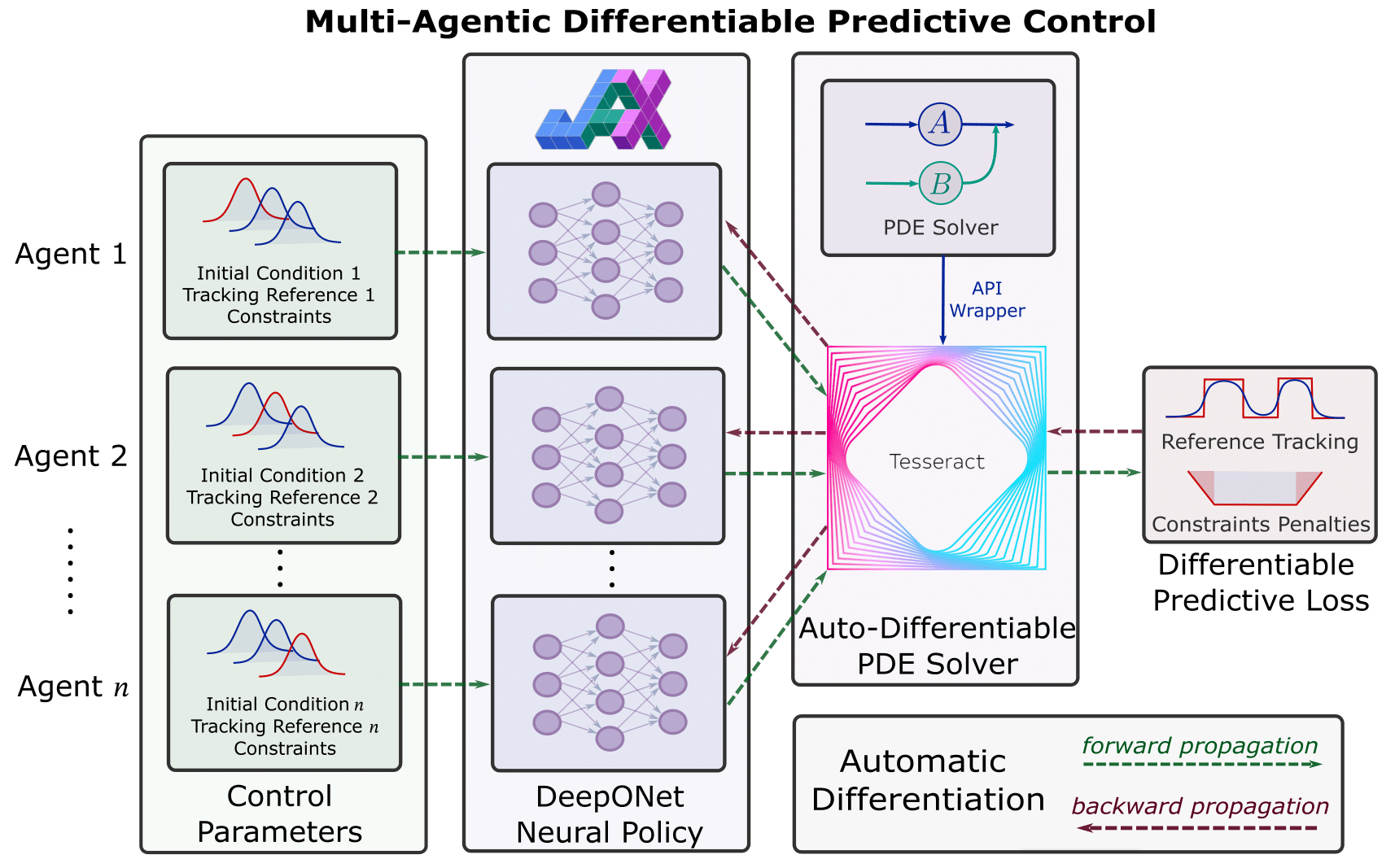
This project addresses a complex decision-making problem within a physical system: how can agents in a flow field (like a moving liquid) collaborate to shape their environment without communicating with each other?
Multi-Agent-DPC answers this question by exploiting a differentiable PDE solver, wrapped as a Tesseract. This way, each agent can learn an action policy via gradient descent that respects the physical nature of their environment, and delivers exact answers to the question “what is the best way to nudge myself and my environment towards the desired state X”. And since the PDE solver is abstracted away as a Tesseract, switching out one environment for another is simple without any code changes and without compromising end-to-end differentiability. This unlocks not just one demo application on a single problem, but a re-usable pipeline that supports any differentiable simulator.
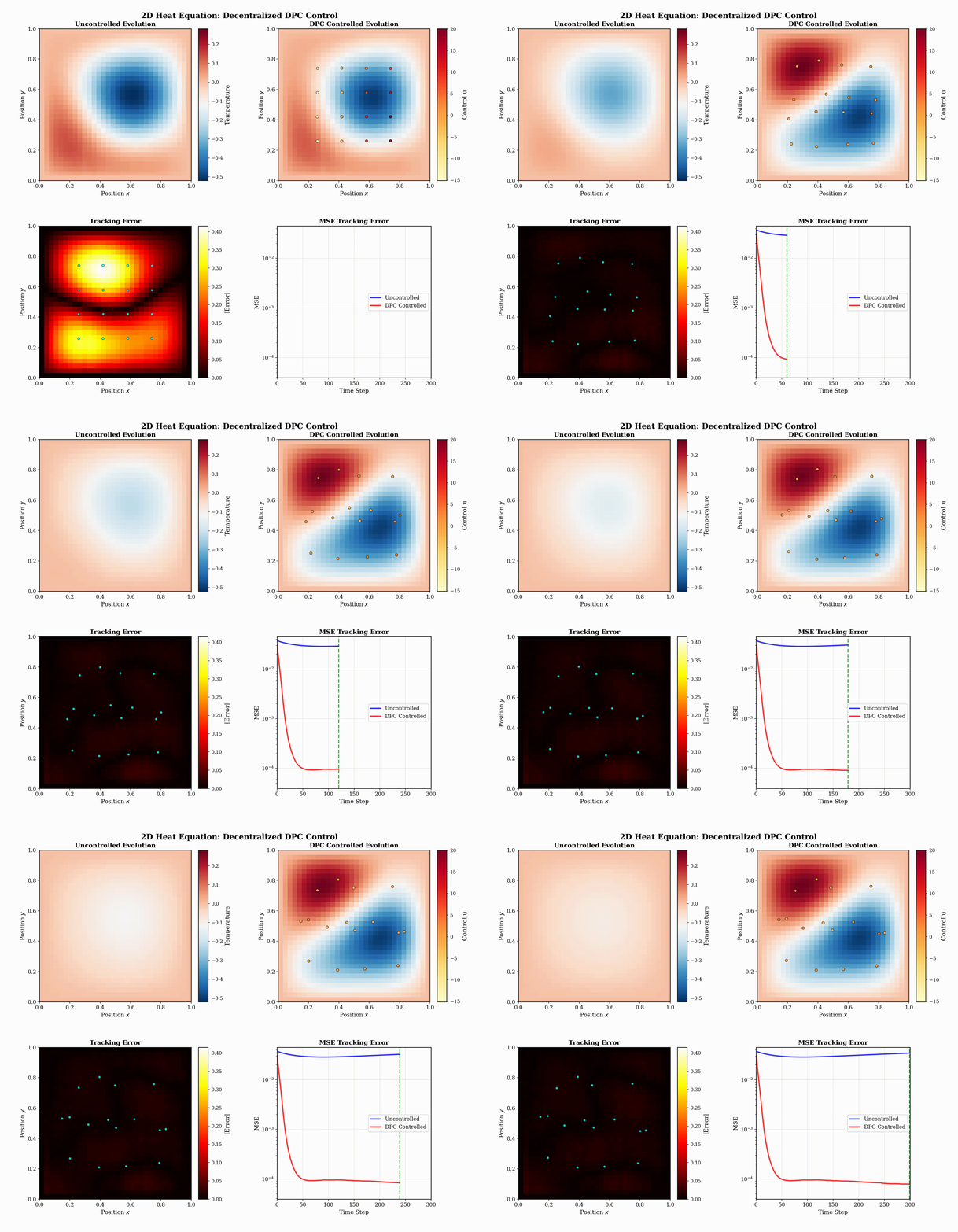
The results speak for themselves, where the authors show that policies trained on a set of 20 agents are still useful when actually deploying 60 agents. 🤯
This is an impressive research project that demonstrates how Tesseracts can be embedded into highly non-trivial applications. Congratulations to the authors, and make sure to check out the excellent (and comprehensive) project README!
2nd Place: DeepSwingr – A Differentiable Framework for Cricket Ball Swing Optimization
Author: Pavan Govindaraju
Source Code | Author Submission
At first glance, this project might seem like fun and games… but trajectory optimization is a problem of interest to those working in fields ranging from robotics to aerospace, even if they aren’t cricket fans. Using Tesseract and Tesseract-JAX, this project presents a complex but well-reasoned optimization pipeline composed of four Tesseracts that each have a distinct purpose:
- Physics backend: Computes forces acting on the ball based on its state.
- Integrator: Performs numerical integration of the equations of motion to predict the ball's trajectory.
- Swing logic: A higher-order Tesseract (HOT) that orchestrates the integrator and physics backend to determine the final deviation of the ball.
- Optimizer: Searches for optimal parameters by interacting with the swing logic Tesseract.
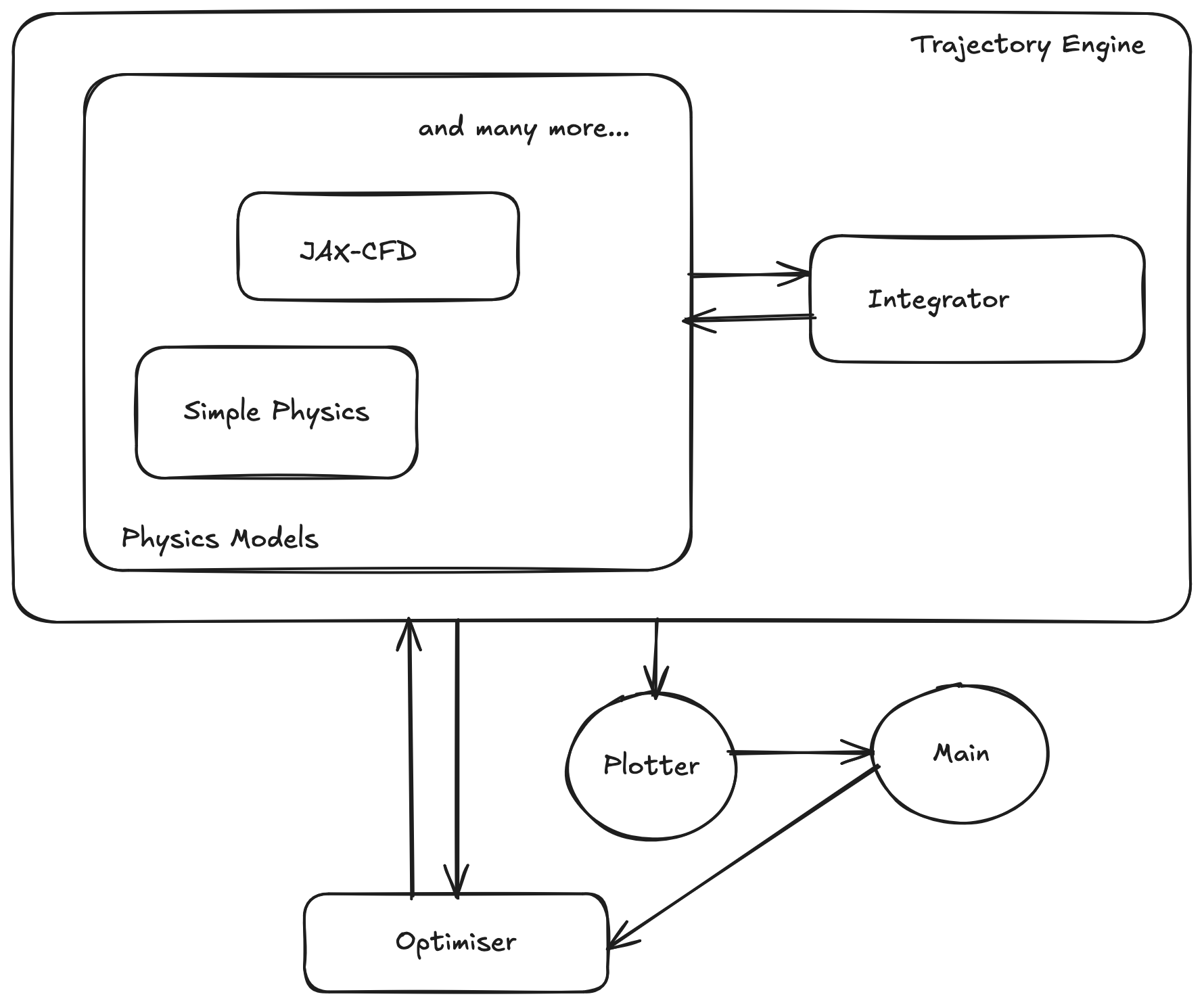
We love how DeepSwingr showcases the sort of modularity that Tesseract’s containerization makes possible by design, with pipeline components such as the physics backend being swappable for other Tesseracts as needed.
Social Media Bonus: PruneDeepONet
Author: Tomoki Koike
Source code | Author submission
As part of the submission process, hackathon teams were asked to post their projects to social media to share with our community. This entry using Tesseract to compare two surrogate architectures was far and away the most viral project!
Honorable Mentions
Choosing the hackathon winners was no easy job for our judges, with a number of fantastic solutions having great potential for future development. In particular, we would like to highlight three strong runners up:
- Diffopteract: Differentiable Optimization in JAX via Julia/JuMP Tesseract authored by Laurens Lueg.
- DiffPIC: Differentiable Particle-in-Cell Optimization with Tesseract authored by Alejo Ballester, Rushan Zhang, Tage Burnett, and Harshavardhan Harish.
- Tesseract-pinn-inverse-burgers: Backend-Agnostic Inverse 1D Burgers Solver via Tesseract authored by Julian Chan.
Huge thanks to all of the participating teams for investing your time and ideas into our first virtual hackathon. We hope to see these projects continue to evolve and grow over time, and can’t wait until the next community event.
Get started with Tesseract
Feeling inspired by Tesseract’s differentiable pipeline potential? Head to the Tesseract documentation to learn how to get started. Tesseract Core is free, open source, and backed by a supportive community.
You can also be the first to know about future Tesseract events and updates by signing up for our forum. While you’re there, be sure to check out even more potential applications of Tesseract in the ever-growing Community Showcase.